President Jan called the Rotary Club #4 meeting to order at 12:32 p.m. on Wednesday, October 15, 2025 at the Washington Athletic Club in downtown Seattle.
The song of the Day: This Land Is Your Land, sung by Trish Bostrom and Jevon Powell.
Faith Ireland introduced former Seattle Police Chief Carmen Best as the newest Rotary Club member.
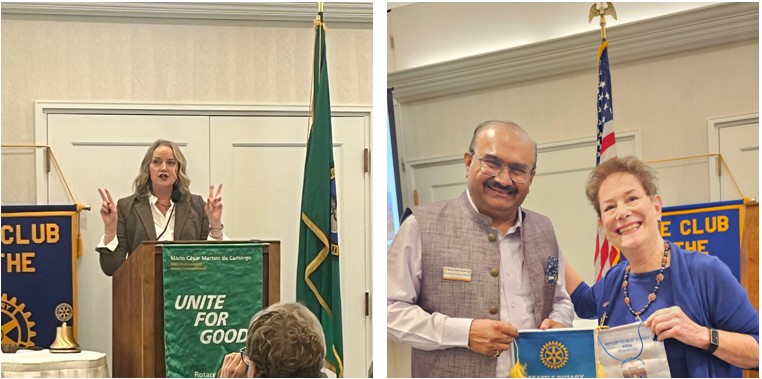
Jon Bridge introduced the main speaker of the day: Shannon Braddock.
King County Executive Braddock expressed her appreciation for having her as a speaker for Seattle Rotary and how honored she is for having served as King County Executive for a short eight-month term. She said she “stepped into this position following Dow Constantine’s departure to lead Sound Transit, after serving as his Deputy Executive. It’s been an extraordinary opportunity to continue advancing King County’s True North vision: creating a welcoming community where every person can thrive.”
Ms. Braddock said when she began in April, she introduced a 200-day plan to guide her short-term goals and set the stage for future leadership. This plan focuses on four key areas: regional readiness, responsible budgeting and resisting federal rollbacks; prioritizing children, working families, and vulnerable residents; running an efficient, “best-run” government; and ensuring a smooth leadership transition.
The first major challenge we faced was fiscal — a $150 million general fund shortfall that grew to $175 million by June. Our general fund supports essential programs like public safety, legal defense, human services, and homelessness response, and we cannot simply transfer money from other restricted areas. Fortunately, the County Council approved a 0.1% criminal justice sales tax, preventing deep cuts, including the potential loss of 80 sheriff’s deputies.
At the same time, uncertainty at the federal level has created serious risks for critical local programs — especially in health care, housing, and human services. With the Affordable Care Act and Medicaid facing threats, up to 67,000 King County residents could lose coverage, with another 215,000 statewide at risk. In response, we established a $31 million Medicaid contingency fund using hospital tax dollars to temporarily buffer against potential cuts. We also prepared to cover emergency WIC funding to ensure women and children wouldn’t lose access to basic nutrition assistance.
Housing stability and homelessness remain urgent challenges. Federal cuts and the expiration of pandemic-era aid threaten many shelter programs. One SODO shelter serving 269 adults is only funded through May 2027. To address needs regionally, we’ve invested $3 million in youth homelessness prevention and another $3 million to create 81 new shelter beds in Federal Way, in partnership with the King County Regional Homelessness Authority and our 39 cities.
Behavioral health is another top priority. Following voter approval of the Crisis Care Centers Levy in 2023, we’re building five regional crisis centers and one for youth. The first opened in Kirkland, and a second site has been secured in Seattle’s Capitol Hill neighborhood through collaboration with Mayor Bruce Harrell. We’ve also expanded our mobile crisis teams to reach people experiencing mental health crises in the field.
Finally, we’re investing in food security — a deeply personal issue for me since my first volunteer experience was in a food bank. The County has allocated $4 million to strengthen food access, including $2 million in capital support for food banks, $1.2 million through a USDA grant for local farmers, and $755,000 redirected to enhance hunger relief infrastructure through Harvest Against Hunger.
As my term nears its end, I remain deeply grateful for the community’s partnership and commitment to building a healthy, thriving King County for all.
The meeting adjourned at 1:32 p.m.
Please consult the weekly newsletter for future meetings and Rotarian activities.
-Appreciate the wonderful report as always, Paul!