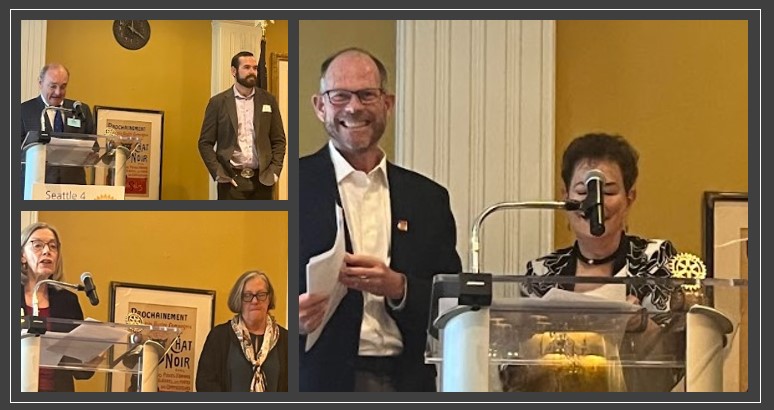
At the Rotary Club of Seattle’s April 22 meeting, Gates Foundation CEO Mark Suzman delivered a stark yet hopeful message about global health, poverty, and the role of philanthropy in a turbulent world. Speaking to Rotarians gathered under the theme of global citizenship, Suzman argued that the world has the tools to save millions of lives—but risks losing hard-won gains without renewed political will and focused investment.
Suzman opened by linking his own journey to Seattle with Rotary’s long history of service and the legacy of the Gates family. He reminded the audience that the Foundation’s roots run through Seattle and Rotary itself, noting that Mary Gates and Bill Gates Sr. were both deeply involved in the organization and passed those values on to their children. “The same values that have shaped Rotary since the beginning also gave birth to the Gates Foundation,” he said, emphasizing the shared ethic of service above self.
Drawing on his upbringing in apartheid-era South Africa, Suzman described how systemic injustice shaped his worldview. “Systems don’t fail by accident,” he said. “They are a reflection of a society’s values, and when people are denied opportunity at scale, it’s because someone decided explicitly or implicitly that their lives mattered less.” Citing Nelson Mandela’s famous declaration that poverty is “man-made and can be overcome,” Suzman stressed the line that has guided his career: “Overcoming poverty is not a gesture of charity. It is an act of justice.”
Suzman celebrated the global progress of the early 21st century, when child deaths fell by more than half and deaths from HIV/AIDS, tuberculosis and malaria declined sharply. “That progress was not accidental. It was not inevitable,” he told the audience. “It was the result of deliberate choices, sustained political commitment, scientific innovation and an insistence on measuring what worked and then scaling it for the people who needed it most.”
But he warned that this momentum is now in jeopardy. Conflict, climate disasters, rising extreme poverty and major cuts in foreign aid have reversed trends that once seemed firmly positive. “Early estimates suggest that in 2025, for the first time this century, preventable child deaths went up rather than down,” Suzman said. “The irony is the world has never had better tools for saving lives than we do right now. The problem is not a lack of opportunity, it’s a lack of will.”
One of the strongest examples of deliberate, sustained effort, Suzman said, is Rotary’s decades-long fight against polio. In 1988, polio paralyzed 350,000 children annually; by 2025, that number was under 60. “More than 3 billion children have received polio vaccines, averting at least a million deaths and 20 million cases of paralysis. None of this would have been possible without Rotarians,” he said. The Gates Foundation has committed nearly $10 billion to polio eradication, maintaining a two-for-one match on
Rotary contributions. Suzman expressed confidence that polio will be eradicated in the “not very distant future,” even as conflict zones in Afghanistan and Pakistan pose enduring challenges.
Looking ahead, Suzman outlined the Foundation’s new strategic horizon: a planned 20-year acceleration ending with the closure of the Gates Foundation in 2045. Over that period, the Foundation intends to roughly double what it has spent in its first 25 years. Its work will center on three ambitious goals: ensuring no mother or child dies of a preventable cause; freeing the next generation from deadly infectious diseases; and enabling hundreds of millions of people to escape poverty and move toward lasting prosperity.
Achieving that vision, Suzman argued, requires grappling with three “hard truths.” First, self-reliance in low- and middle-income countries cannot be achieved without additional resources, especially where debt payments already outstrip spending on health and education. Second, aid must be more sharply focused on proven interventions that help the poorest survive and thrive—particularly in global health—rather than serving as a catch-all for disparate initiatives. Third, genuine progress demands that local leaders and institutions drive change, from clinics and schools to data systems and, increasingly, artificial intelligence.
On AI, Suzman described both a powerful opportunity and a clear risk. Tools built primarily in English and a handful of other languages, he warned, may simply fail the communities they are meant to serve. “An AI tool that may work perfectly for a school or hospital in Seattle might not work in South Africa,” he said. The Foundation is now funding expanded language datasets across Africa and Asia and exploring ways to protect sensitive health and education data in low-resource settings. “This is one of the most important issues we are facing nationally and globally right now—what does AI for good actually look like?” he said.
Suzman acknowledged that the Foundation has faced heightened skepticism and conspiracy theories in recent years, particularly during the COVID-19 pandemic and surrounding debates over the World Health Organization. He called such narratives both troubling and operationally harmful, but said the only viable response is openness and a continued focus on impact. “We truly have no agenda other than the one I described—to help build a world where every person has the chance to live a healthy and productive life,” he told Rotarians, noting that every grant and partnership is publicly listed. “It’s appropriate to have a degree of scrutiny when you have great concentrations of wealth. Our job is to be transparent and let our work and our partners speak for themselves.”
In the Q&A, Suzman highlighted concrete local and global projects—from a health research center in Kilifi, Kenya, to education and youth initiatives in King County—that illustrate the Foundation’s shift toward building durable local capacity. He also described high-risk investments such as funding final trials for a potential new tuberculosis vaccine, a project with “a 50 percent chance of success or failure” but transformative potential if it works. Ultimately, he said, philanthropy at its best is “catalytic,” taking risks others cannot in order to unlock longer-term public and private solutions.
The meeting was also a celebration of community and continuity within the Rotary Club of Seattle. Members heard tributes to longtime Rotarian Don Craft and news of a generous bequest to the club foundation from the Craft estate. The club welcomed new members Kathy Cloutier, executive director of the Refugee Women’s Alliance, and Alexander Cyrus, a certified financial planner and incoming club treasurer. Music from Trish Bostrom and Jevon Powell set a tone of service and solidarity, while
announcements underscored just how tightly the club’s local work is interwoven with its global concerns.
In the weeks ahead, Seattle Rotarians will move from talk to action through a packed calendar of events. Members are mobilizing for a cleanup at the Seattle Boys and Girls Club, continuing a long-standing relationship with the organization. They are also supporting the “All Out for Autism” 5K with the Bellevue morning Rotary club. A series of programs will follow: a Zoom session with retired Rear Admiral Bill Center on global citizenship; a May 6 luncheon at the Washington Athletic Club with Hip Hop is Green founder Keith Tucker on environmental and food justice; a May 13 evening event with Cascade PBS featuring local media personalities Rachel Belle and Paris Jackson; Rotary Day at the University of Washington on May 19; a May 20 lunch program with Julia Carboni of WSU’s Ruckelshaus Center on collaborative local problem-solving; a May 21 appreciation event for major donors to the Seattle Rotary Service Foundation; and, on May 27, both a Zoom program with philanthropy leader Dave Spicer and an ethnic dinner organized by the club’s cultural events committee.
Closing the meeting, Rotary Club president Jan Levy tied Suzman’s global narrative back to Seattle’s civic DNA and the example of Mary Gates. For Levy, the lesson of the afternoon extended far beyond the Gates Foundation’s campus. “If there’s a takeaway from me, it’s this,” she told members. “Global citizenship does not require a boarding pass, just a willingness to care beyond your own immediate horizon".
-Thanks for the comprehensive report this week, Logan! And enjoy the sun this weekend!