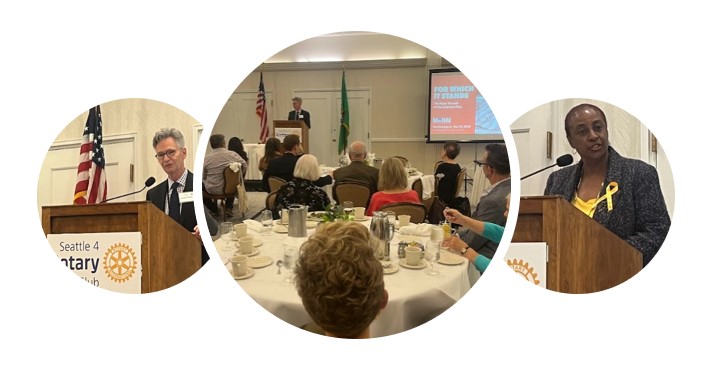
Seattle Rotary Club members gathered this week for a wide-ranging program that linked philanthropy, historical memory, and civic responsibility, highlighting both $200,000 in new Rotary grants and the upcoming arrival of America’s foundational documents at the Museum of History & Industry (MOHAI).
The meeting opened with Lillian Sherman announcing the Seattle Rotary Service Foundation’s latest grant awards. The International Service Committee received 21 proposals, reviewed 14, and selected 13 international partners. Locally, the new Local Service Committee reviewed more than 33 proposals, brought eight forward for presentation, and ultimately chose four grantees: FareStart, School Connects Washington, Operation Nightwatch, and UW Business Mentors, alongside continued support for Harvest Against Hunger and the Rotary Boys & Girls Club.
“These grants, in total $200,000, will revitalize downtown, address homelessness and food insecurity, promote education, and save lives around the world,” Sherman said. “This is Service Above Self in action.” She urged members who have not yet contributed to the foundation to join in: “For the 35% of you who haven’t made a gift to SRSF yet this year, there is still time… Together we can still do more.”
Music and inspiration framed the theme of service. Linda and Jevon led the club in Glen Campbell’s “Try a Little Kindness,” preceded by a story about how audiences “don’t care if you mess up” when the intention is sincere.
Tracy Brown followed with a reflection on museums and monuments as guardians of civic memory. She described MOHAI as “a treasure space that guardians our Puget Sound collective memory, connecting the past and the present, inspiring future generations,” and highlighted the life of Dr. George Edmund Haynes, co-founder of the National Urban League. Brown connected his legacy to the Extra Mile Pathway in Washington, D.C., which honors individuals whose volunteerism and civic engagement have driven social change.
Club President Jan Levy then introduced Leonard Garfield, Executive Director of MOHAI, as the day’s featured speaker and one of the region’s most respected public historians. Garfield began by placing Seattle Rotary in the long arc of local history. “When we talk about history, Rotary Four, you guys are history,” he said. “And I mean that in the best possible way. Your legacy in this community, going all the way back to the early 20th century, is truly remarkable.”
Garfield previewed “Freedom Plane: Documents That Forged a Nation,” an unprecedented traveling exhibit of 12 foundational U.S. documents, from the Articles of Association and an early engraved Declaration of Independence, to Valley Forge oaths of allegiance, the Treaty of Paris, a draft Constitution, and a marked-up Bill of Rights. Seattle will serve as the final stop on an eight-city national tour.
“These are what they call vault-level documents,” Garfield explained. “They’ve never been gathered together outside Washington, D.C., and they’re seldom even seen there.” The documents will arrive July 27 on a specially outfitted 737 dubbed the Freedom Plane, organized by the National Archives and National Archives Foundation and supported nationally by Boeing and Microsoft. In Seattle, admission
will be free for the public throughout the 18-day run, thanks to support from Amazon, the Gates Foundation, Boeing, and individual donors.
“At a time when we are in a fractious civic environment, these are the documents that bind us together,” Garfield told Rotarians. “They allow us to imagine a future that is as rich and glorious as the founders envisioned.” He walked members through the significance of several pieces, including the Articles of Association, which signaled a new sense of shared identity among colonies, and Valley Forge oaths of allegiance, where soldiers pledged loyalty not to a king but to the emerging United States. A Senate markup of the Bill of Rights will show, in his words, “democracy in action for the first time,” capturing how early lawmakers debated and refined the liberties Americans now take for granted.
Beyond the documents themselves, MOHAI will present a companion exhibit of historic American flags—from early territorial flags and wartime banners to Jim Whittaker’s Everest flag and one made by a granddaughter of Betsy Ross—exploring the many meanings the flag has carried over 250 years. Programs will include a youth-focused “freedom of the press” activity, a lecture by historian Clint Smith on the contradictions and promises of American history, a public conversation with local elected officials on democracy in the 21st century, and a September event with tribal communities examining the relationship between the U.S. founding documents and Indigenous sovereignty.
Garfield closed his remarks with a practical reminder. “Here’s the key, folks: everything’s free, but you have to reserve your tickets,” he said. Tickets are available through mohai.org, with advance reservations for MOHAI members until June 15 and general public access beginning afterward.
The club also took time to recognize its own evolving story. Past President Jimmy Collins welcomed back Ben Linford, a returning member with a long Rotary record in Anchorage and Seattle and recent service on the Rotary Foundation Investment Committee, overseeing major global portfolios. Linford, an investment leader and songwriter, recently won first place in the country category of the Great American Song Contest and has been exploring the role of artificial intelligence in creative work and service.
Looking ahead, Nicole outlined several key dates. District 5030 is seeking candidates for District Governor 2029–2030, inviting past presidents to consider this leadership role and contact President Jan, incoming President John, or current District Governor Jeff Borek. Members will celebrate the close of Jan’s presidential year at the President’s Party on Thursday, June 11, at Queen City Yacht Club, with food, fellowship, and salsa dancing. The final luncheon of the Rotary year will be held Wednesday, June 17, at the WAC, featuring Lou Rochelle Rim Atkins on racial equity and community impact and the traditional passing of the gavel. The club will then recess from June 19 to July 3, returning Wednesday, July 8, in a larger room at the WAC for the first meeting under President John, with Seattle Mayor Katie Wilson as guest speaker.
In her closing reflection, Jan tied the program’s threads together—Rotary grants, MOHAI’s stewardship of history, and the broader work of building a just and resilient city. “Seattle has always been a city focused on what’s next,” she said, yet “healthy communities need both hope for the future and a memory of the past.” Encouraging members to visit MOHAI and to keep investing in the community, she summed up the charge to Rotarians: “Healthy communities are built by people who can look backward with gratitude, forward with hope, and then get on with the work present.”
-Thanks as always, Logan!